|
Confidential & Covered: Legal & Policy Highlight
Q: What are the state laws and policies that represent at least partial solutions to the conflict between insurance coverage and confidentiality protections?
State laws and policies that represent at least partial solutions include strategies that implicate both Medicaid and commercial insurance. They include: Medicaid’s good-cause exception; restrictions on disclosure; confidentiality protections for minor or adult dependents; management of EOBs, denials, and other communications; and implementation strategies.
These state-level efforts began in conjunction with and following the promulgation of the HIPAA Privacy Rule and have accelerated with the advent of the ACA.
To learn more about the strategies that some of these states have taken, read "Confidentiality, Third-Party Billing, & The Health Insurance Claims Process: Implications for Title X." (PDF)
Julie Lewis is a Policy Director at NFPRHA who oversees on the Confidential & Covered project, which is designed to better understand insurance use and confidentiality at Title X-funded family planning health centers. Contact her at jlewis@nfprha.org or 202-293-3114 ext. 214 for more information.
NFPRHA's Get Covered: Family Planning Member Spotlight
NFPRHA members across the country are assisting patients in getting covered during the third open enrollment period under the Affordable Care Act (ACA). Each month, Reproductive Health Watch features a NFPRHA member who has taken on the crucial task of helping patients get enrolled with a Q&A about their outreach and enrollment efforts.

This month NFPRHA is featuring Maria De La Cruz, Human Service Program Manager, Client Access, at the Houston Health Department (HHD). Maria manages a team of Client Access Specialists and Service Linkage workers in the city's health centers and multi-service sites who connect and enroll clients to services, including health insurance, SNAP, TANF, housing, education, mental health referrals, and employment opportunities.
What does the enrollment work look like inside HHD health centers and multi-service sites?
When clients come in for any service they see and hear information about enrollment throughout their visit - from the conversations they have with staff at check-in to materials like banner stands promoting the ACA. During the second open enrollment period, we had ACA organizers from NFPRHA who set up information tables in the health center waiting area. The tables were always very interactive (lots of balloons and fun hand-outs like coloring books for children) with brochures and fliers about the ACA. We have continued with this model and now the tables are staffed by members of our enrollment team. HHD has 22 Client Access Specialists onsite to assist clients in determining eligibility into various health insurance programs, including the marketplace. We have cross-trained an additional 26 employees, from all areas of the health center, as Certified Application Counselors. They help to back up the Client Access Specialists during busy times like the last month of open enrollment. We also participate in as many outreach enrollment events as possible throughout the city like health fairs and community festivals. We are currently in the process of planning a training for local faith-based organizations. Our goal is to provide faith leaders with information, resources and messaging they can use when speaking from the pulpit to their congregations about the importance of health coverage.
What kind of partnerships does HHD have in its enrollment work?
Getting the word out about enrollment is definitely a team effort! HHD is in its third year of leading 20 local organizations in the Enroll Gulf Coast Health Insurance Marketplace Collaborative (Collaborative). Members of the collaborative include Enroll America, Young Invincibles, the Houston Area Urban League, Texas Organizing Project and many more. The purpose of the Collaborative is to provide outreach, education and health insurance enrollment for uninsured eligible individuals and families in Houston. HHD utilizes the Incident Command Structure (ICS) developed by the National Incident Management System to coordinate the activities in the Collaborative. The ICS structure is an organizational protocol normally reserved for disaster response, but it is well suited to organize and implement policies and actions across disparate groups. The use of the ICS proved to be successful in the first two years of the ACA Marketplace. During the second open enrollment, the Collaborative had 223,698 conversations with Houston residents and estimated that consumers saw or heard information about the ACA through media ads, billboards, phone calls and other venues 16,190,249 times.
What have been your biggest challenges?
One of our biggest challenges is that Texas has not expanded Medicaid so there is a large population that we are not able to enroll. Another challenge is that many of the people who remain uninsured are much harder to reach than the ones who enrolled during the first two open enrollment periods. We currently work with the Collaborative, faith based groups, Spanish-language media like Univision and Telemundo, the Hospital district (county health coverage), and the local school districts. Despite these efforts, we know because of the uninsured rate in Houston that there are people who are still not getting information. We are always looking for opportunities to reach new populations.
Would you like to share information about the enrollment work your health center is doing? Contact Claire Manning, NFPRHA’s Field Director, at cmanning@nfprha.org or 202-251-8240, to be featured next month.
New HCPCS Codes Established for Mirena and Liletta
The Centers for Medicare & Medicaid Services (CMS) has released its 2016 HCPCS index, which includes revisions to HCPCS codes used for the two 52mg levonorgestrel-releasing IUDs now available on the market. These products are commonly referred to under the manufacturer brand names Liletta® (Medicines360) and Mirena® (Bayer).
Effective January 1, 2016, CMS will discontinue use of the HCPCS code J7302 for 52mg levonorgestrel-releasing IUDs and begin using the following codes:
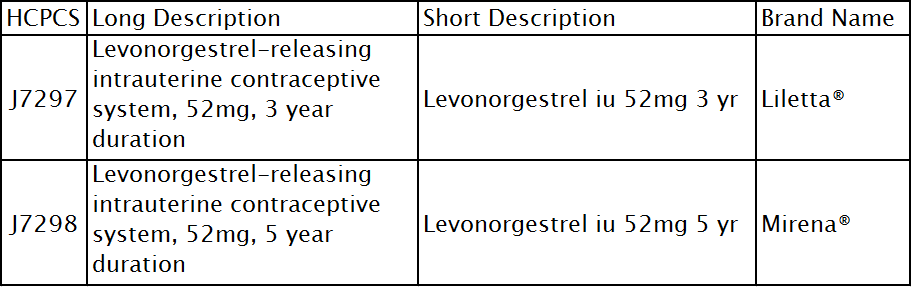
HCPCS codes for the 13.5mg levonorgestrel-releasing IUD (J7301) (brand name Skyla®) and the intrauterine copper contraceptive (J7300) (brand name ParaGard®) remain unchanged.
Providers should consult all third-party payers to confirm specific coding requirements.
Amanda Kimber Kelinson is a Manager for NFPRHA’s Health Care Delivery function and primarily responsible for member assistance related to revenue cycle management. Please contact Amanda at 202-293-3114 ext. 215 or akelinson@nfprha.org with any questions or concerns.
top
|